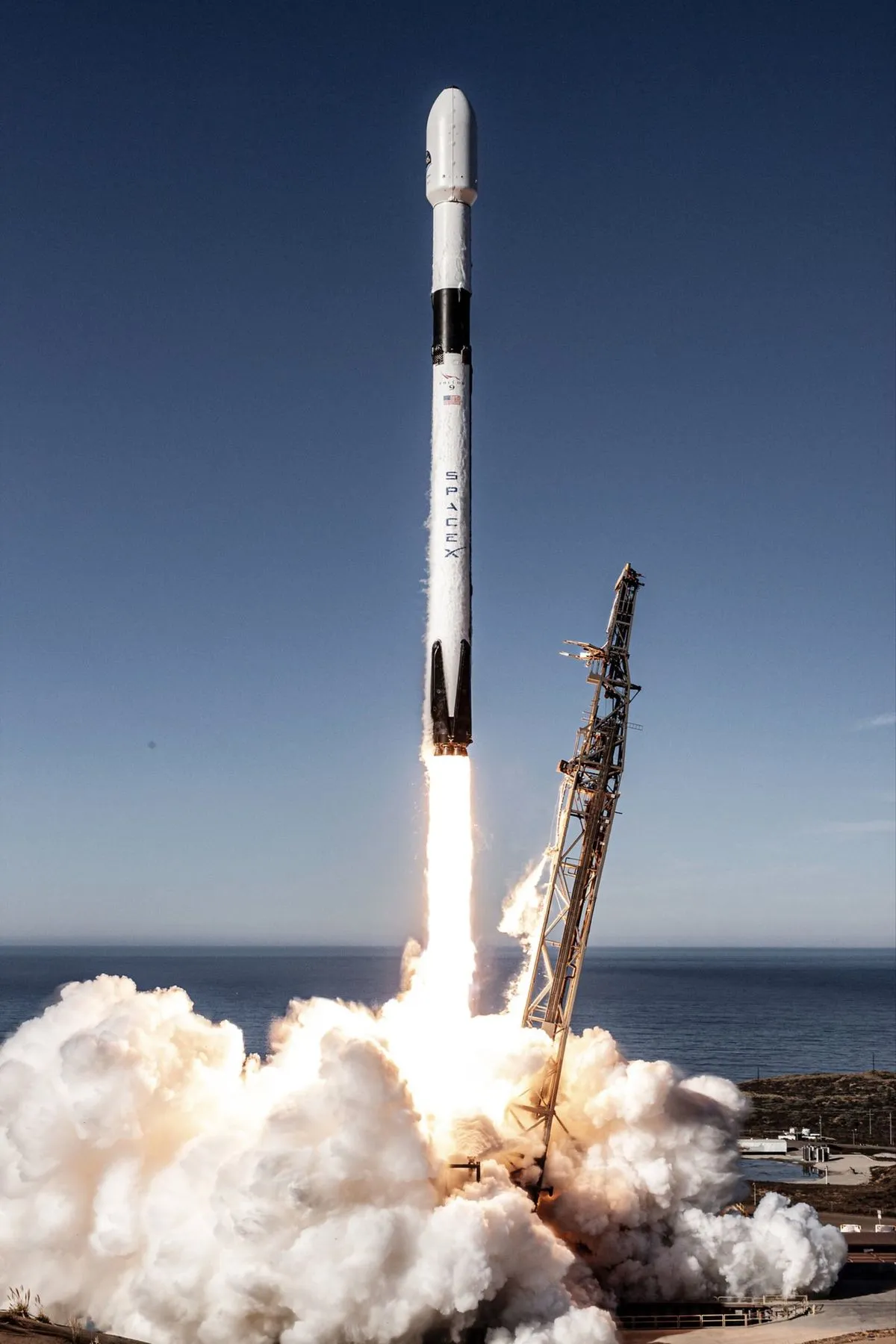
India’s private space industry reached another important milestone when multiple Indian space technologies were carried into orbit aboard SpaceX’s Falcon 9 as part of the Transporter-18 rideshare mission. The launch, conducted from Vandenberg Space Force Base in California on October 1, 2026, placed a range of small satellites and payloads into orbit, including technologies developed by Indian space startups.
Among the Indian contributions was Dhruva Space’s LEAP-2, a commercial hosted-payload platform based on its P-30 satellite platform. LEAP-2 hosted multiple in-orbit demonstration missions, including a star tracker developed by France-based Sodern ArianeGroup and TAPAS-1, a thermal-imaging payload developed by India-based SatLeo Labs. The mission demonstrates how Indian companies are increasingly participating in the space economy not only as satellite manufacturers but also as developers of specialised space technologies and mission infrastructure.
Transporter-18 and the Rise of Commercial Space Rideshare
SpaceX’s Transporter programme provides a rideshare model in which numerous spacecraft and payloads can travel to orbit on a single launch. This approach has become important for startups and organisations that need access to space without having to arrange an entire dedicated rocket launch.
Transporter-18 carried around 130 payloads, including satellites, hosted payloads and orbital transfer vehicles from organisations around the world. The Falcon 9 lifted off from Vandenberg Space Force Base on October 1, 2026, carrying missions involving Earth observation, communications, propulsion, computing and other technologies.
For emerging Indian space companies, such rideshare missions can provide an opportunity to test new technologies in actual orbital conditions. Instead of waiting to develop a complete large satellite and arrange a dedicated launch, companies can integrate specific technologies onto established spacecraft platforms or participate through shared launches.
This is the principle behind Dhruva Space’s LEAP programme.
What Is Dhruva Space’s LEAP-2 Mission?
LEAP stands for Launching Expeditions for Aspiring Payloads. Dhruva Space developed the programme to provide organisations with access to its P-30 satellite platform for hosted payload and in-orbit demonstration missions.
LEAP-2 is the programme’s second commercial mission. The P-30 platform provides a modular spacecraft architecture capable of accommodating different payloads. According to Dhruva Space, the platform supports hosted payload missions, in-orbit validation and demonstration, multi-payload configurations and operations in low Earth orbit.
The hosted-payload approach is significant because a company developing a sensor or other space technology does not necessarily need to build every part of a satellite itself. A hosted mission can provide the spacecraft platform and associated infrastructure needed to take a technology from development on Earth to testing in orbit.
Dhruva Space also handled the end-to-end integration of LEAP-2 with SpaceX’s Falcon 9. This expands the company’s role from spacecraft development into launch integration and broader mission delivery.
TAPAS-1: India’s Commercial Thermal Imaging Technology
One of the most notable payloads hosted on LEAP-2 is TAPAS-1, developed by Ahmedabad-based SatLeo Labs.
TAPAS-1 is designed to demonstrate thermal sensing and data-processing capabilities in orbit. It uses long-wave infrared sensing to capture information about land-surface temperatures that conventional optical imaging cannot directly provide. SatLeo Labs describes the mission as a dedicated commercial thermal payload and intends to use the experience as a foundation for future thermal-imaging capabilities.
Thermal imaging has applications across several fields. Agricultural organisations can potentially use temperature information to study crop conditions and environmental stress. Urban planners can examine heat patterns across cities, while disaster-management systems can benefit from information related to fires and other thermal events.
The technology can also contribute to infrastructure monitoring and broader environmental observation.
The company has outlined plans for a future thermal-imaging constellation called PYRO, with a proposed network of 10–15 satellites by 2029. TAPAS-1 therefore serves not only as an individual technology demonstration but also as an important orbital test for the company’s longer-term commercial plans.
Why Thermal Data Matters
Conventional Earth-observation satellites frequently rely on visible and other optical wavelengths to produce images. Thermal sensors provide a different form of information by detecting infrared radiation associated with temperature.
This difference can make thermal observations useful when an area looks similar in an ordinary photograph but has meaningful temperature differences.
For example, two sections of land may appear visually similar while having different surface temperatures because of variations in vegetation, moisture, materials or human activity. Thermal data can help reveal those differences.
TAPAS-1 is intended to demonstrate whether SatLeo’s sensing and processing technology can work effectively in the orbital environment. Successful validation could support the development of larger commercial systems capable of producing more frequent thermal observations.
Sodern’s HORUS Star Tracker on LEAP-2
LEAP-2 also carries the HORUS star tracker from France-based Sodern ArianeGroup.
A star tracker is an important spacecraft instrument used to determine the orientation of a satellite. It works by observing stars and comparing their positions with known celestial patterns. This information allows the spacecraft to establish its attitude in space with high precision.
Dhruva Space says the HORUS payload features an advanced space detector designed for autonomous and high-precision attitude sensing. The company and Sodern are using LEAP-2 for an in-orbit demonstration of the technology.
The collaboration also reflects the international nature of the modern commercial space industry. Indian spacecraft platforms can provide opportunities for international companies to test specialised technologies, while Indian startups can gain experience through partnerships with established global space organisations.
Other Indian Technologies on Transporter-18
LEAP-2 was not the only Indian contribution to the Transporter-18 mission.
Hyderabad-based TakeMe2Space also launched its MOI-1A spacecraft, designed around orbital computing. The mission is intended to demonstrate the processing of Earth-observation information directly in orbit rather than transmitting all raw data to ground stations first.
The broader Indian participation also involved technology developed by EON Space Labs, whose payload was associated with the TakeMe2Space mission. Together with Dhruva Space and SatLeo Labs, these companies demonstrate the expanding range of capabilities being developed by India’s private space sector, from spacecraft platforms and thermal sensing to onboard computing and Earth observation.
What This Means for India’s NewSpace Industry
The significance of Transporter-18 goes beyond a single rocket launch. It highlights a changing structure within India’s space ecosystem.
Indian private companies are increasingly working across different parts of the space value chain. Some are developing satellites, while others are concentrating on sensors, propulsion, communications, data processing, Earth observation and other specialised technologies.
Hosted-payload programmes such as LEAP-2 can also lower some of the barriers associated with orbital technology demonstrations. By sharing spacecraft and launch infrastructure, companies can focus more closely on the technology they need to validate.
For startups, this can be particularly important because space hardware must operate under conditions that cannot always be fully reproduced on Earth. An orbital demonstration can reveal how a technology performs after exposure to the actual space environment.
The Road Ahead for Indian Space Startups
The Transporter-18 mission illustrates how India’s space sector is gradually moving from traditional satellite development toward a broader commercial ecosystem.
LEAP-2 demonstrates the potential of hosted payload services. TAPAS-1 represents progress in commercial thermal Earth observation, while MOI-1A highlights the development of onboard computing capabilities.
These technologies serve different purposes, but they share a common requirement: proving that innovative systems can operate reliably in space.
As Indian startups continue to develop specialised technologies and seek international launch opportunities, missions such as Transporter-18 can become important stepping stones between laboratory development and commercial deployment.
The Falcon 9 launch therefore represents more than another rideshare mission. It places several Indian-developed technologies into the real operating environment of space and provides valuable opportunities for orbital validation. For companies such as Dhruva Space and SatLeo Labs, the success of these demonstrations could help determine how quickly experimental technologies develop into larger commercial products and services.
India’s private space sector is consequently expanding from building spacecraft to developing complete capabilities around launch access, hosted payloads, Earth observation, thermal intelligence, onboard computing and space-based data services. The Transporter-18 mission provides a clear example of that transition and shows how Indian startups are becoming increasingly integrated into the global commercial space ecosystem.
Read more – grammarthink.com