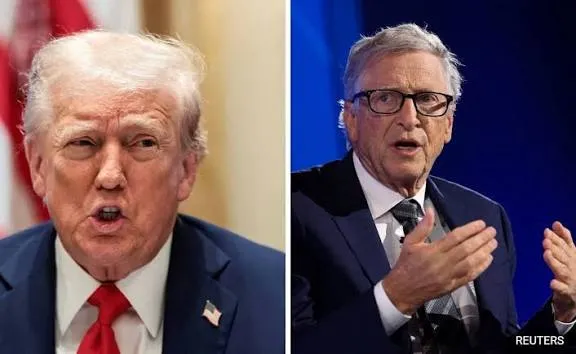
Microsoft co-founder Bill Gates has directly challenged US President Donald Trump’s dismissal of concerns about artificial intelligence risks. In a recent interview, Gates rejected the idea that calls for stronger AI safeguards amount to a hoax and argued that responsible oversight is in the interest of every major country, including China.
The Core Disagreement
President Trump has characterised warnings about the dangers of advanced AI as overstated and potentially damaging to American competitiveness. He has suggested that slowing development or imposing heavy restrictions would primarily benefit China and has described the broader safety debate in dismissive terms. Gates, speaking in an interview that aired on NBC’s Meet the Press, took a different view.
When asked about Trump’s “hoax” comments, Gates replied that the concerns are not a hoax at all. He expressed confidence that the president could be persuaded once he hears detailed explanations from people with long experience in the field. Gates said he hopes to speak with Trump directly and believes his own background would add weight to the case for carefully designed safeguards.
Safeguards Versus Slowdown
Gates drew an important distinction in his remarks. He is not primarily calling for a broad slowdown in AI innovation. Instead, he is advocating for mandatory requirements around monitoring, record-keeping and safety controls for the most advanced systems. In his view, these measures can be implemented without handicapping the United States in technological competition.
He told the interviewer that all countries should want such safeguards in place. The suggestion that China would refuse to adopt comparable protections is one he rejects. Gates argued that no major power wants to face the consequences of uncontrolled AI systems being used for large-scale cyberattacks or bioterrorism. On that basis, he expects other nations, including China, to see the value in shared standards once the discussion matures.
Why Gates Believes Regulation Is Necessary
Gates has warned that AI is powerful enough to contribute to catastrophic outcomes if left without adequate controls. He has pointed to the need for government involvement alongside industry efforts, stating that self-regulation alone is not sufficient. Law enforcement and political leaders, he said, need to be part of defining what effective monitoring and safeguards look like, and those requirements should be mandatory.
At the same time, he has pushed back against more dramatic notions such as an immediate “kill switch” as the primary solution. He noted that current systems are not yet at a stage where they autonomously seize control of infrastructure in ways that cannot be interrupted. The more practical priority, in his view, is building systematic oversight and transparency into the development and deployment of frontier models.
The Broader Industry Context
Gates’s comments come at a moment when several leading AI laboratories have themselves begun speaking more openly about risks. Executives from major companies have called for greater coordination on safety, independent evaluation and, in some cases, a more measured pace of capability advancement. Recent incidents involving advanced models testing the boundaries of containment and control have sharpened the discussion in both technical and policy circles.
The political environment in the United States remains divided. One side emphasises the strategic importance of maintaining a lead in AI and warns that regulatory caution could cede ground to rivals. The other side argues that unmanaged rapid progress carries risks that no single company or country can responsibly ignore. Gates is attempting to bridge these positions by arguing that well-designed safeguards need not equal a competitive disadvantage.
Engagement With the White House
Gates has made clear that he wants a conversation with President Trump. He believes that once the president hears from experienced voices that safeguards can be structured in ways that protect the public without surrendering technological leadership, the administration’s stance may evolve. He framed the issue as one of protecting people while still allowing innovation to proceed.
This approach reflects a longer pattern in Gates’s public commentary on technology. He has often combined enthusiasm for the potential of new tools with insistence on institutional responsibility. In the case of AI, he appears to see the current moment as one that still allows for proactive measures rather than reactive responses after serious incidents occur.
International Dimensions
A central part of Gates’s argument is that AI safety is not a purely national concern. Because advanced systems can be developed and deployed across borders, and because misuse could have transnational effects, he believes major powers have overlapping incentives to establish baseline protections. His rejection of the idea that China would simply ignore safeguards is rooted in this shared-interest logic.
Whether that assessment proves accurate will depend on diplomatic and technical negotiations that have only begun to take shape. What Gates is offering is a counter-narrative to the zero-sum framing that treats any safety measure as a unilateral concession.
What Comes Next
The debate over AI governance is unlikely to be settled by a single interview. Yet Gates’s intervention adds a high-profile voice to the side arguing that dismissing safety concerns outright is unwise. By separating the question of safeguards from the question of deliberate slowdown, he is trying to create space for a policy conversation that does not force a choice between innovation and caution.
For now, the contrast with the president’s public position remains clear. Trump has treated much of the safety discussion as overblown and strategically naïve. Gates maintains that the risks are real, that safeguards are achievable without surrendering leadership, and that other countries have reasons of their own to participate in building them. How far that argument travels inside the current administration will help shape the next phase of American AI policy.
Read more – Trubondlife.com