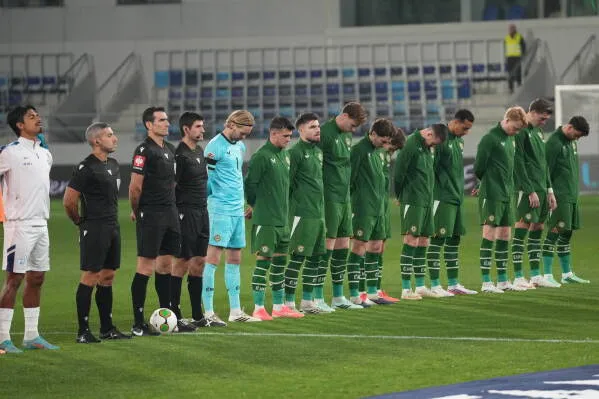
Ireland’s national football team once more used pre-match formalities to register a visible protest during their second UEFA Nations League encounter with Israel. On Sunday, 4 October 2026, the players wore black armbands, bowed their heads during the Israeli national anthem, and declined the customary handshake with their opponents before a 1-1 draw played behind closed doors in Bačka Topola, Serbia.
The gestures repeated those seen a week earlier in Debrecen, Hungary, where Ireland had won 3-0. Together the two matches have become among the most politically charged fixtures in recent European qualifying, reflecting wider public and political debate in Ireland over the conflict in Gaza.
Consistent Gestures Across Both Matches
In the first meeting, Ireland captain Dara O’Shea shook hands with the referee and assistants but kept his hands behind his back when approaching Israel captain Manor Solomon. There was no exchange of pennants and no line of player handshakes. All Ireland players wore black armbands, which the Football Association of Ireland said were intended “in recognition of all lives lost in the conflict.” During the playing of Hatikvah, the Irish squad stood with heads lowered.
The same pattern was followed in Serbia. With O’Shea absent to be with his wife for the birth of their child, goalkeeper Caoimhín Kelleher assumed the captaincy. He completed the formalities with the match officials but pointedly avoided shaking hands with Israel captain Dor Peretz. The black armbands remained, and the players again bowed their heads for the Israeli anthem.
Israel’s players also wore black armbands, in their case marking the memory of those killed in the Hamas-led attacks of 7 October 2023. Peretz had “7.10” written on his armband.
Context of the Protest
The fixtures had been contentious from the moment the draw placed the two sides in the same Nations League group. In Ireland there were public calls for a boycott. The squad held extensive internal discussions before the first match. A significant majority voted to fulfil the fixtures, while agreeing they would not take part in the traditional handshake or pennant exchange. UEFA was informed in advance and accepted the arrangement.
One player, goalkeeper Gavin Bazunu, withdrew from both matches. He stated that his decision rested on a personal belief that “the killing of innocent people is wrong” and that it would be wrong for him to participate. His departure underscored the depth of feeling within parts of the squad even as the majority chose to play under protest.
Ireland’s head coach later said the players had “raised awareness worldwide” through their actions. The FAI framed the armbands as a recognition of all lives lost rather than a targeted political statement against one side.
On-Field Tension
Both matches carried an edge that extended beyond the pre-match ceremony. In Hungary, Ireland scored three times in the first half to secure a convincing win. In Serbia the contest was tighter and more fractious. Troy Parrott converted a penalty to give Ireland the lead before half-time. A sideline disagreement occurred as the teams left the pitch. Early in the second half Peretz equalised, and the game finished 1-1.
The absence of spectators in Serbia, ordered because of security and political sensitivities, created an unusually quiet backdrop that made the pre-match gestures and on-pitch confrontations more conspicuous.
Broader Reactions and Implications
The Irish actions have been interpreted differently by different audiences. Supporters of the protest view the armbands, bowed heads and refused handshakes as a legitimate and restrained expression of solidarity with Palestinian civilians and a refusal to conduct “business as usual” amid ongoing violence. Critics argue that the gestures politicise sport, selectively target Israel, and risk creating an atmosphere of hostility toward Israeli athletes who have no direct role in government policy.
UEFA’s decision to allow the matches to proceed while accepting the modified formalities reflects the governing body’s preference for keeping fixtures on the calendar even when political tension is high. The choice of neutral venues—Hungary for the first match and Serbia for the second—further illustrated the practical difficulties of staging the ties in either country under current conditions.
For the players themselves the episode has required navigating competing pressures: the expectation to represent their country, personal moral convictions, collective squad decisions, and the knowledge that every gesture would be scrutinised and amplified.
Sport in a Polarised Climate
The Ireland–Israel Nations League meetings belong to a growing list of sporting encounters in which athletes have used pre-match rituals to signal positions on international conflicts. Black armbands, silence during anthems, and the refusal of handshakes have become recognised, if contested, forms of expression within the constraints of competition rules.
Whether such actions influence public opinion or policy remains debatable. What is clear is that they place athletes in the middle of debates that extend far beyond the pitch. In this case the Irish squad chose a middle path: they fulfilled the fixtures, thereby avoiding the sporting and regulatory consequences of a boycott, while consistently declining the symbols of normal sporting camaraderie.
The 1-1 draw in Serbia concluded the two-legged confrontation for this Nations League campaign. The sporting results will feed into the group standings. The images of bowed heads, black armbands and avoided handshakes are likely to endure longer in public memory, illustrating how deeply external conflicts can intrude into the ceremonial and competitive spaces of international football.
Read more – carandbikejunction.com