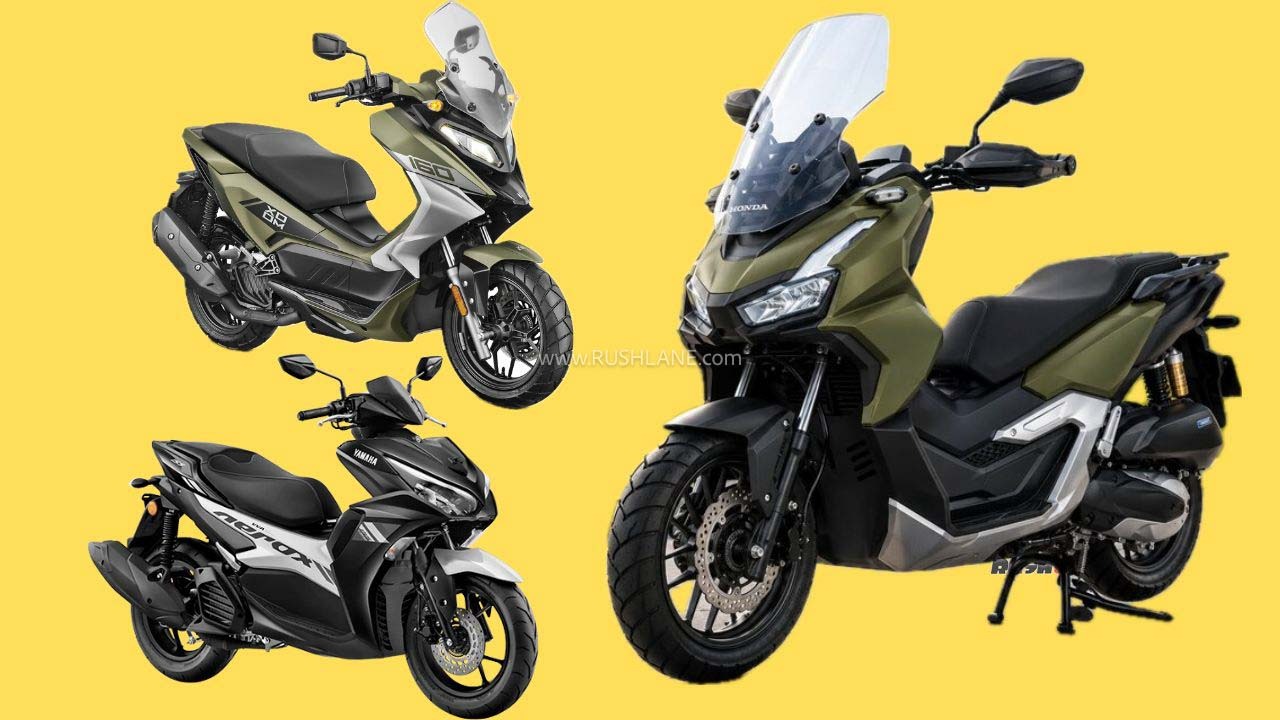
The premium scooter market in India has become much more interesting with Honda entering the segment with the ADV 160 E85. Honda ADV 160 is positioned as a more feature-loaded alternative to the Yamaha Aerox 155 and Hero Xoom 160, while also bringing something neither rival currently offers, namely E85 flex-fuel compatibility.
Three Scooters, Different Personalities
The Honda ADV 160, Yamaha Aerox 155 and Hero Xoom 160 may look like direct rivals, but their approach is actually quite different. The Aerox focuses strongly on sporty performance and lightweight handling, while the Xoom 160 tries to mix adventure styling with everyday practicality. Honda takes the more premium route with stronger equipment, adventure-focused styling and flex-fuel technology.
Honda has priced the ADV 160 at Rs 1.70 lakh ex-showroom, with deliveries expected to begin around mid-October 2026. The Yamaha Aerox 155 sits around the Rs 1.46 lakh to Rs 1.50 lakh range depending on variant, while the Hero Xoom 160 is positioned around Rs 1.43 lakh to Rs 1.49 lakh in current pricing references.
That price difference matters quite a bit for buyers who are watching their budget closely. The Honda costs noticeably more, so the extra money needs to make sense through equipment, technology, practicality and engine capability.
Honda ADV 160 Brings E85 Technology
The biggest talking point around the Honda ADV 160 is not actually its styling or engine output. It is the E85-compatible flex-fuel technology, which allows the scooter to run on fuel containing up to 85 percent ethanol under suitable fuel availability and specifications. This makes the Honda particularly interesting as India continues moving toward higher ethanol blending.
The ADV 160 uses a 156.9cc liquid-cooled single-cylinder engine and produces around 16 PS, according to current India-focused specification reports. The Yamaha Aerox 155 produces around 15 PS, while the Hero Xoom 160 sits close behind with roughly 14.6 to 14.8 PS depending on the specification source.
The Honda therefore has the strongest peak power figure among these three scooters on paper. However, real-world performance cannot be judged only from maximum power numbers, because gearing, throttle calibration, weight and engine response also influence how a scooter feels in everyday traffic.
Aerox 155 Still Has Lightweight Appeal
The Yamaha Aerox 155 has one very obvious advantage when the numbers are placed beside its competitors. It is considerably lighter, with a kerb weight of about 126 kg, compared with around 133 kg for the ADV 160 and approximately 142 kg for the Xoom 160.
That lower weight can make a noticeable difference during city riding. Moving through narrow gaps, changing direction quickly and handling the scooter while parking can feel easier when the machine weighs less. The Aerox also has a sporty riding character that has already made it popular among performance-focused scooter buyers.
Its 155cc liquid-cooled engine uses Yamaha’s sporty engine technology, and the scooter remains an attractive option for riders who care more about acceleration and handling than adventure styling or maximum equipment.
Xoom 160 Takes A Different Route
Hero Xoom 160 does not try to copy the Aerox completely. Its larger body and adventure-inspired styling give it a different presence on the road. The scooter weighs around 142 kg, making it the heaviest option in this comparison, but that extra mass comes with a larger physical footprint and a more substantial maxi-scooter appearance.
The Xoom 160 uses a 156cc liquid-cooled single-cylinder engine producing around 14.6 to 14.8 PS and 14 Nm of torque, depending on the specification reference. Its 7-litre fuel tank is also larger than the Aerox’s roughly 5.5-litre tank.
For buyers who want a scooter that looks bigger and more touring-oriented without moving into a much more expensive segment, the Xoom 160 makes a reasonable case. It also benefits from Hero’s broad service presence across India, which can matter considerably outside major cities.
Features Make Honda Stand Out
The Honda ADV 160 has the strongest equipment list among these three scooters on paper. It gets a 5-inch TFT instrument cluster, Honda RoadSync connectivity, traction control, an adjustable windscreen, LED lighting and an idling stop system. It also gets a larger fuel tank and more under-seat storage than its two competitors according to current comparison data.
The Yamaha Aerox 155 also offers useful technology, including smartphone connectivity, navigation-related functions and keyless ignition on applicable variants. Some versions also offer traction control, which keeps Yamaha competitive even though its overall dashboard package is less premium than Honda’s TFT setup.
Hero’s Xoom 160 comes with smartphone connectivity, navigation functions and keyless features, giving it a respectable equipment package for its price. The difference is that Honda appears to have concentrated more technology into the ADV 160 rather than simply matching the basic features offered by rivals.
Size And Ground Clearance Matter
For Indian roads, dimensions are not just numbers printed on a specification sheet. Ground clearance, wheel size, seat height and overall weight can influence how comfortable a scooter feels on broken roads and crowded streets.
The ADV 160 has a reported seat height of around 780 mm, making it the lowest among these three. The Xoom 160 is around 787 mm, while the Aerox 155 sits near 790 mm. The ADV also offers around 165 mm ground clearance in current reports, while the Xoom provides about 155 mm and the Aerox around 145 mm.
That makes the Honda particularly interesting for riders who regularly encounter speed breakers, rough patches or uneven roads. Its adventure styling is not only cosmetic either, because the riding position and clearance are clearly part of its broader design philosophy.
Brakes And Suspension Stay Similar
There is less separation between the three scooters when braking and suspension hardware is compared. All three use telescopic front suspension and twin rear shock absorbers, while single-channel ABS is available across the comparison.
Honda and Hero use a 240mm front disc, while the Yamaha Aerox 155 uses a 230mm front disc. All three continue with a rear drum brake setup in the specifications compared by major automotive publications.
Tyre sizes are another interesting difference. The Xoom 160 gets wider tyres, while the Aerox uses a wider rear tyre than Honda. The ADV 160 uses a 14-inch front wheel and 13-inch rear wheel, whereas both the Aerox and Xoom use 14-inch wheels at both ends.
Price Difference Could Decide Everything
Price is where the comparison becomes much harder for Honda. The ADV 160’s Rs 1.70 lakh ex-showroom price puts it roughly Rs 20,000 or more above the Aerox 155 in current comparisons. The Xoom 160 is also significantly cheaper, with current figures around the Rs 1.43 lakh to Rs 1.49 lakh range depending on variant and source.
So the Honda is not simply another affordable alternative in the segment. It is a premium-priced scooter that needs buyers to value its additional technology and flex-fuel capability.
For someone who wants the lowest purchase cost, the Aerox or Xoom can make more sense. But someone looking for the newest technology, larger fuel capacity, adventure styling and E85 compatibility may consider the Honda’s higher price easier to justify.
Which Scooter Makes More Sense?
There is no single winner for every type of rider because these scooters are aimed at slightly different priorities. The Aerox 155 remains attractive for riders who want lightweight handling, sporty styling and a proven performance-focused package.
The Hero Xoom 160 looks more suitable for buyers who want adventure-inspired styling, a larger scooter footprint and competitive pricing without paying Honda’s premium. Its wider tyres and larger fuel tank also add some practicality for everyday riding.
The Honda ADV 160 is the most technologically ambitious option here. It offers the strongest power figure, E85 flex-fuel capability, traction control, TFT instrumentation, adjustable windscreen, lower seat height and generous fuel capacity.
Final Verdict For Indian Buyers
The Honda ADV 160 E85 changes the premium scooter comparison by adding technology that the Yamaha Aerox 155 and Hero Xoom 160 currently do not offer. Its higher price is certainly noticeable, but the additional equipment, stronger output, larger fuel tank, better ground clearance and flex-fuel capability give Honda a distinctive position. The Aerox remains the lighter and more performance-oriented choice, while the Xoom 160 offers a practical middle ground at a lower price. Buyers should compare on-road prices, local fuel availability, service support and intended riding conditions before making the final decision. For the latest variant pricing and availability, check the manufacturer and authorised dealer information before booking your scooter.
Read More :- cekilisimizvar.com