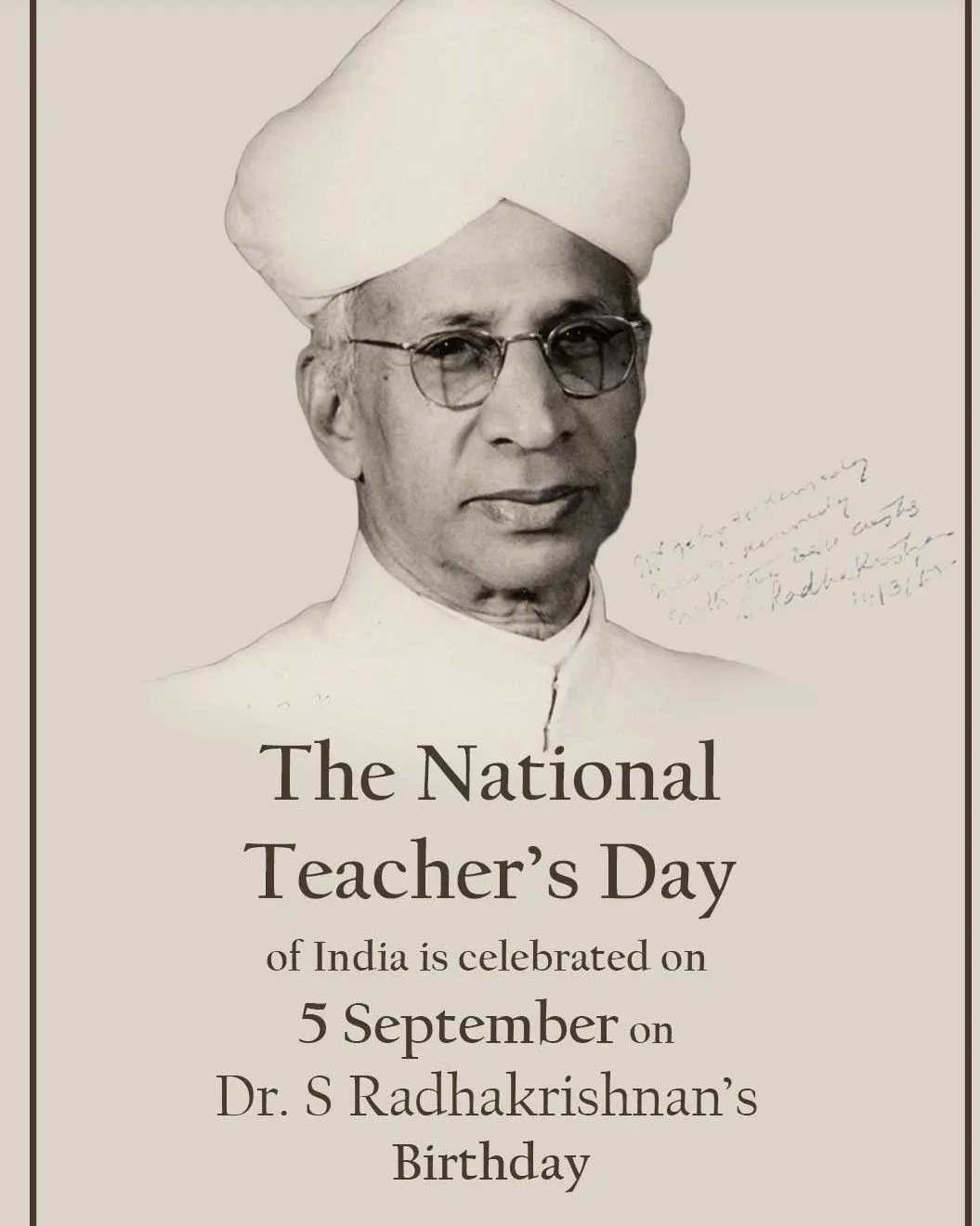
Every year on 5 September, India observes Teachers’ Day as a national occasion to honour educators. The date is not arbitrary. It marks the birth anniversary of Dr Sarvepalli Radhakrishnan, a philosopher, scholar, teacher and statesman who served as India’s first Vice-President from 1952 to 1962 and its second President from 1962 to 1967. The decision to dedicate the day to teachers rather than to a personal birthday celebration came from Radhakrishnan himself and has shaped the way the country remembers both the man and the profession he held in high regard.
The Origin of Teachers’ Day in India
The tradition began in 1962. After Radhakrishnan assumed the office of President, his former students and admirers approached him with a request to celebrate his birthday. Instead of accepting a personal tribute, he suggested that 5 September be observed as Teachers’ Day. He believed the day should recognise the contribution of all teachers rather than focus on one individual. The idea was accepted, and the first Teachers’ Day was celebrated that same year while he was still in office.
This choice reflected a consistent theme in his life. Although he later held high constitutional positions, Radhakrishnan always identified himself primarily as a teacher. He once remarked that he would feel privileged if the day were used to honour the teaching community. That simple preference turned a personal milestone into a lasting national observance.
Early Life and Academic Journey
Sarvepalli Radhakrishnan was born on 5 September 1888 in Tiruttani, then part of the Madras Presidency and now in Tamil Nadu, into a Telugu-speaking family of modest means. His father worked as a subordinate revenue official. Education became the path that transformed his circumstances. He studied philosophy and went on to teach at several leading institutions, including Madras Presidency College, the University of Mysore and the University of Calcutta.
His academic reputation grew steadily. He was appointed to the prestigious King George V Chair of Mental and Moral Science at Calcutta University and later became the Spalding Professor of Eastern Religions and Ethics at the University of Oxford, one of the first Indians to hold such a chair. He also served as Vice-Chancellor of Andhra University and of Banaras Hindu University, succeeding Madan Mohan Malaviya at the latter. These roles placed him at the centre of higher education in India during a period of significant intellectual and institutional change.
Philosopher, Scholar and Public Figure
Radhakrishnan’s writings helped introduce Indian philosophical traditions to a global audience. He interpreted Hindu thought for Western readers while engaging seriously with comparative religion and ethics. His work emphasised the unity of spiritual insight across cultures and the importance of reason alongside faith. These ideas earned him international recognition and strengthened India’s intellectual presence abroad.
In public life he served as India’s Ambassador to the Soviet Union from 1949 to 1952 before becoming the country’s first Vice-President. In 1962 he was elected President. Throughout these years he continued to speak about education as a means of developing independent thinking, democratic values and responsible citizenship. He believed teachers should be among the finest minds in the nation because they shape the character of future generations.
In 1954 he received the Bharat Ratna, India’s highest civilian honour. He passed away on 17 April 1975. September 5, 2026, therefore marks both his birth anniversary and the 51st year since his death.
Why the Connection Still Matters
Teachers’ Day endures because it links a personal story of humility with a broader national value. By refusing a private celebration, Radhakrishnan redirected public attention toward the everyday work of educators. The day now serves multiple purposes. Students express gratitude through cultural programmes, speeches and small gifts. Schools and colleges organise events that place teachers at the centre. At the national level, the President of India presents awards to outstanding teachers, recognising excellence in the profession.
The observance also keeps alive a particular vision of education. For Radhakrishnan, schooling was never only about information or examination success. It was about forming an attitude of reason, a democratic spirit and the capacity for responsible citizenship. That perspective continues to resonate in discussions about the purpose of education in contemporary India.
Celebrations and Continuing Relevance
On Teachers’ Day, classrooms across the country often reverse roles temporarily. Students take on teaching duties or present performances for their teachers. Many former students return to their schools and colleges to meet mentors who influenced their lives. These gestures, repeated year after year, reinforce the idea that teaching is a relationship that extends beyond formal instruction.
The day also prompts reflection on the challenges teachers face and the support they require. By associating the occasion with a figure who combined scholarship, teaching and public service, India maintains a symbolic reminder that education remains foundational to national development.
A Lasting National Tradition
The decision made in 1962 has proved durable. More than six decades later, 5 September continues to be observed uniformly across the country as Teachers’ Day. It is neither a religious festival nor a political anniversary, but a civic occasion rooted in respect for learning and those who transmit it.
Dr Sarvepalli Radhakrishnan’s life supplied both the date and the spirit of the observance. Born on 5 September 1888, he rose from a modest background to the highest offices of the republic while never distancing himself from the identity of a teacher. When offered a personal celebration, he chose instead to honour the profession. That choice turned a birthday into a national day of recognition, and it remains the reason India celebrates Teachers’ Day on Dr Sarvepalli Radhakrishnan’s birthday.
Read more – thenumberinfo.com