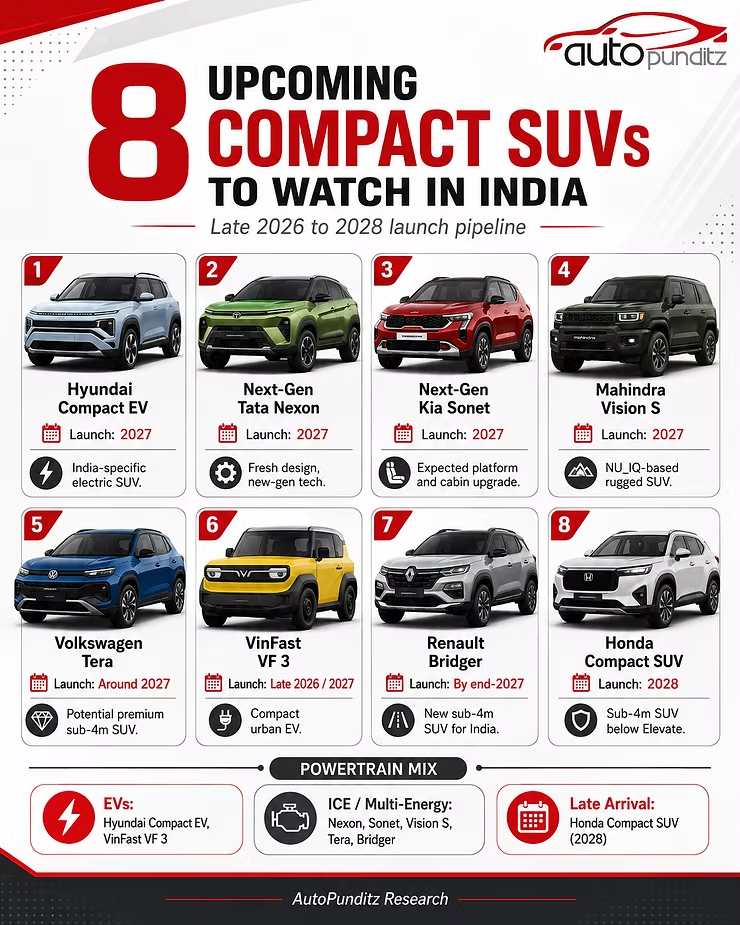
The Indian SUV market is getting crowded, but buyers are still looking for compact models that feel practical, modern, and reasonably affordable. Upcoming compact SUVs in India are expected to bring newer designs, better cabin technology, improved safety equipment, and in some cases electric powertrains as well. Current industry forecasts also show strong SUV demand continuing in India over the coming years.
Why Compact SUVs Are Getting Popular
Compact SUVs make sense for Indian roads because they offer a higher driving position without becoming difficult to handle in busy city traffic. Buyers also get more road presence, decent ground clearance, and useful cabin space without immediately moving into expensive larger SUV territory. This balance is one major reason manufacturers keep expanding their SUV portfolios across different price brackets.
The upcoming launches are especially interesting because manufacturers are not simply adding bigger engines anymore. Some new SUVs are expected to focus heavily on connected features, hybrid technology, electric driving, improved efficiency, and stronger safety packages. That could make the segment much more competitive for buyers.
Renault Duster Makes A Return
The Renault Duster is one of the most interesting names returning to the Indian SUV market, especially because the original model developed a strong following among Indian buyers. Renault officially announced the Duster’s return and said the new model would be revealed in India on January 26, 2026.
The new-generation Duster is expected to target the popular compact and midsize SUV space with a more modern appearance and updated technology. Depending on the final Indian specifications, buyers could see petrol and electrified powertrain options, along with a more premium cabin than the older model offered.
Its biggest challenge will be pricing because the segment already has several strong competitors. Still, the Duster name itself gives Renault an advantage because many Indian buyers already remember the original SUV.
Volkswagen Tera Could Change Things
Volkswagen is also expected to strengthen its SUV portfolio with the Tera, which is listed among upcoming SUV launches for India. Current industry listings place the expected starting price around ₹8 lakh, although the final price and launch details can change before the official announcement.
The Tera is expected to sit toward the smaller end of the SUV market, making it potentially interesting for buyers who want a compact vehicle for everyday city use. Volkswagen could focus on driving dynamics, design, cabin quality, and modern safety technology to separate it from more conventional budget SUVs.
If Volkswagen manages to keep the pricing aggressive, the Tera could become an important model for the brand in India. Buyers in this segment usually compare everything from mileage to maintenance costs, so pricing will matter heavily.
Kia Syros EV Brings Electric Power
Electric SUVs are becoming a bigger part of India’s upcoming-car calendar, and the Kia Syros EV is one model attracting attention. Current listings place the expected price roughly between ₹13 lakh and ₹18 lakh, although these figures should be treated as estimates until Kia confirms final pricing.
The electric version could appeal to urban buyers who want a compact SUV without spending premium money on a larger electric vehicle. Range, charging speed, battery warranty, and real-world efficiency will probably matter more to buyers than flashy features alone.
Kia already has strong familiarity among Indian customers, which could help the Syros EV gain attention when it reaches showrooms. Its success will depend heavily on how competitive the final battery and pricing package becomes.
Maruti Brezza Gets Another Update
The Maruti Suzuki Brezza remains one of the better-known names in India’s compact SUV category, so an updated version naturally gets plenty of attention. Industry listings currently show the Brezza facelift among the upcoming models, with an estimated starting price around ₹8.79 lakh in one current listing.
The update is expected to focus more on refreshed styling, technology, and equipment rather than completely changing the character of the SUV. Maruti’s huge sales network and relatively familiar ownership experience could continue being major advantages for this model.
For buyers mainly interested in daily commuting, fuel efficiency, easy servicing, and resale value, the updated Brezza could remain a straightforward choice. The interesting question will be whether Maruti adds enough new equipment to make existing owners consider upgrading.
Honda Elevate EV Is Worth Watching
Honda is also preparing to expand its electric SUV presence in India, with the Elevate EV appearing on upcoming SUV launch lists. Current estimates put its expected price near ₹18 lakh, although the exact specifications and launch details can change before the company makes a final announcement.
An electric SUV based around the Elevate’s positioning could give Honda a stronger presence in India’s rapidly changing EV market. Buyers will likely look closely at driving range, charging infrastructure compatibility, cabin technology, and battery protection.
Honda has traditionally attracted customers who prioritize comfort and reliability, so the electric version could appeal to a different group of buyers while retaining some of that familiar brand identity.
Hyundai Bayon Could Target Cities
The Hyundai Bayon is another model appearing on current upcoming SUV lists for India, with an estimated price around ₹10 lakh and a projected launch later in 2026.
The Bayon could be particularly relevant for customers wanting something smaller than traditional midsize SUVs. A compact footprint can make parking easier, while SUV styling still gives the vehicle the visual appeal many Indian buyers now expect.
Hyundai’s strong reputation for infotainment, features, interior presentation, and widespread service support could work in the Bayon’s favour. However, the company would need to position it carefully so that it does not create unnecessary overlap with its existing SUV range.
Renault Bigster Looks More Premium
Renault’s Bigster is another upcoming model that could attract buyers looking beyond conventional compact SUVs. Current industry listings estimate its Indian launch toward the end of 2026, with an expected starting price around ₹12 lakh.
The Bigster is expected to offer more space and a larger overall presence than smaller compact SUVs. It could therefore sit between affordable compact SUVs and larger family-focused models, depending on the final Indian positioning.
For buyers who like the Duster concept but want something bigger, the Bigster could become an interesting alternative. Pricing will again be critical because Indian consumers in this range have many established options already.
What Buyers Should Expect Next
The next wave of upcoming compact SUVs in India is not going to be limited to petrol engines and cosmetic updates. Manufacturers are increasingly mixing traditional petrol powertrains with hybrids and full-electric options, giving customers more ways to choose according to their daily driving needs. Current 2026 SUV launch listings already show a large number of electric and updated models entering the market.
Technology will also become a bigger selling point. Larger displays, connected-car functions, advanced driver assistance features, 360-degree cameras, improved lighting systems, and more sophisticated safety equipment are becoming increasingly common.
At the same time, buyers should not choose a car only because its feature list looks impressive. Real-world mileage, service costs, spare-parts availability, charging access for EVs, warranty coverage, and resale value can make a much bigger difference after several years of ownership.
Which SUVs Could Stand Out
There is no single winner because every upcoming SUV will target a slightly different type of customer. The Renault Duster could attract buyers interested in a familiar SUV name with a new-generation approach, while the Brezza may continue appealing to practical family buyers.
Electric models such as the Kia Syros EV and Honda Elevate EV could become more interesting as charging infrastructure improves across Indian cities. Meanwhile, vehicles such as the Volkswagen Tera and Hyundai Bayon may appeal to people who want a smaller footprint without giving up SUV styling.
The final prices, specifications, variants, and launch schedules should always be checked after the manufacturers make official announcements because current industry estimates can change. Several upcoming-car databases themselves describe these prices and dates as expected rather than confirmed information.
Final Word For SUV Buyers
The next generation of compact SUVs in India looks considerably more varied than what buyers had only a few years ago. Petrol models, electric SUVs, refreshed favourites, and returning nameplates are all fighting for attention, which should ultimately give consumers more choices. The Renault Duster comeback, updated Brezza, Kia Syros EV, Honda Elevate EV, Volkswagen Tera, and Hyundai Bayon are among the names worth watching closely during this period. However, buyers should compare official prices, specifications, safety equipment, running costs, and warranty terms before making a final decision. Keep following reliable automotive updates for confirmed launch dates, prices, and detailed specifications before booking your next SUV.