Ambitious plans for permanent human presence on the Moon are gathering pace. Both NASA and China are focusing on the lunar south pole, where permanently shadowed craters are believed to lock away water ice that could support future bases. Visionaries have spoken of self-sustaining settlements and even cities. Yet a recent scientific analysis delivers a sobering assessment: the available water may support far smaller populations, and for far shorter periods, than many enthusiasts assume.
The Promise of Polar Ice
The Moon’s polar regions contain craters whose floors have remained in permanent shadow for billions of years. Temperatures in these cold traps can stay low enough that water ice, once deposited, does not easily escape into space. Orbital missions have detected hydrogen signatures and, in some cases, direct evidence of ice in these locations. Space agencies view this resource as critical. Water can be used for drinking, hygiene, oxygen production through electrolysis, and even rocket propellant when split into hydrogen and oxygen.
This potential has made the south pole the preferred site for upcoming missions and proposed outposts. NASA’s Artemis programme and China’s lunar exploration plans, including elements of a future research station, both prioritise the region. The logic is clear: local resources reduce the enormous cost of launching every necessity from Earth.
A Quantitative Reality Check
Astronomers Martin Elvis and Jonathan McDowell examined the sustainability of lunar settlements by comparing estimated water reserves with projected human demand. They adopted a deliberately generous baseline of one billion tonnes of water ice—an upper-end figure that exceeds many current estimates. Even under this optimistic assumption, the numbers are constraining.
Human water use, including consumption, hygiene, food production and industrial processes, was assessed at a level that makes large populations difficult to sustain. Without any recycling, a city of one million people would exhaust a billion-tonne reserve in only a few years. With recycling efficiency matching the roughly 98 percent achieved on the International Space Station, the same population would deplete the supply in about a century.
If the actual quantity of accessible ice is substantially lower—as some analyses suggest, possibly by a factor of 20 or 30—the timelines shrink dramatically. In that case, even modest settlements would face earlier shortages.
Power Is Less of a Constraint
Interestingly, the same analysis found that energy supply is less problematic. A city of one million people would require substantial power, on the order of a couple of gigawatts. Near the poles, peaks of near-permanent sunlight could support large solar arrays. Nuclear systems offer another option. In principle, energy for lighting, habitat systems, industry and water processing appears more solvable than the water supply itself.
This contrast sharpens the central finding: water, not power, is the binding constraint on the scale and longevity of lunar habitation.
Implications for Settlement Scale
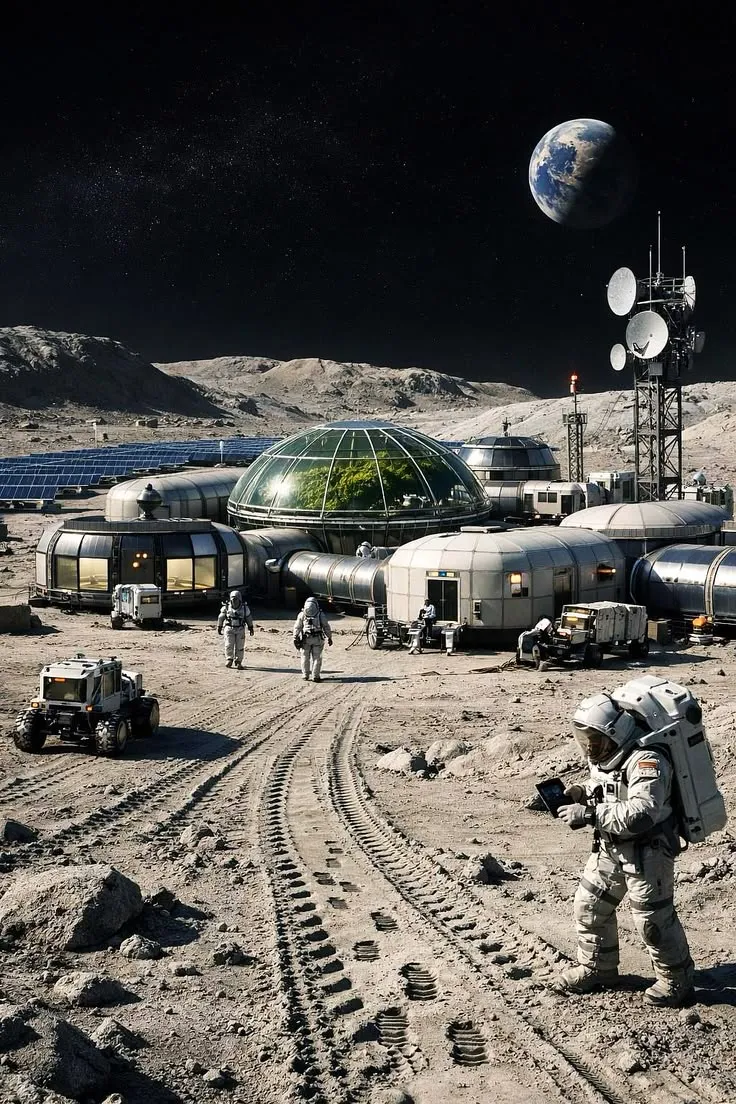
The calculations favour smaller outposts over sprawling cities. A community of one thousand to ten thousand people, operating with high recycling rates, could potentially draw on polar ice for several centuries. Such a scale aligns more closely with scientific research stations or limited industrial footholds than with the self-growing cities some entrepreneurs have imagined.
Larger ambitions would require breakthroughs. Recycling efficiency would need to rise well above current space-station performance, approaching near-total recovery of every drop. Water demand could be reduced through advanced closed-loop agriculture, such as highly efficient vertical farming. Additional water might be imported from water-rich asteroids, though that introduces its own logistical and economic challenges. Or more ice than currently estimated might be discovered and proven accessible.
Uncertainties in the Resource Base
Estimates of lunar water remain uncertain. Different instruments and modelling assumptions produce varying figures for total volume, concentration and distribution. Much of the ice may be mixed with regolith, locked in forms that are difficult to extract, or located in terrain that is challenging for landers and rovers. Extracting, purifying and storing the resource in useful quantities will itself consume energy and infrastructure.
Permanently shadowed regions are extremely cold and dark, complicating operations. Robotic prospectors and eventual human crews will need specialised systems to work in these environments. Until detailed ground-truth measurements are obtained, planners are working with incomplete information.
The Broader Context of Lunar Ambitions
The interest in polar ice reflects a shift from short flags-and-footprints missions toward sustained presence. Water is central because it multiplies the value of every other activity: life support becomes less dependent on Earth resupply, propellant can be manufactured locally, and industrial processes gain a critical feedstock. Entrepreneurs have linked these possibilities to visions of lunar manufacturing and even larger demographic ambitions.
The new analysis does not rule out human activity on the Moon. It does, however, impose quantitative discipline on those visions. A research village or a modest industrial outpost looks more realistic, on current resource knowledge, than a metropolis. Sustainability measured in centuries rather than millennia may still be valuable, but it requires deliberate design choices about population size, recycling performance and resource strategy.
Looking Ahead
Upcoming missions will refine the picture. Robotic landers and hoppers aimed at the south pole are expected to sample shadowed terrain, measure ice content more precisely and test extraction techniques. Those data will allow better models of how much water is truly recoverable and at what cost.
Until then, the message from the resource calculation is clear. The Moon’s polar ice is a genuine asset, yet it is finite and possibly more limited than optimistic scenarios assume. Cities on the Moon, if they are to exist, will need extraordinary efficiency, careful population planning, or supplementary water sources. Without those, the dream of large, long-lived lunar settlements risks running dry far sooner than many currently expect. The south pole may host humanity’s next outpost, but the scale of that presence will be shaped as much by the physics of water as by engineering ambition.
Read more – blessandseemusic.com